Memory Boost Worksheets: Printable & Digital Recall Practice
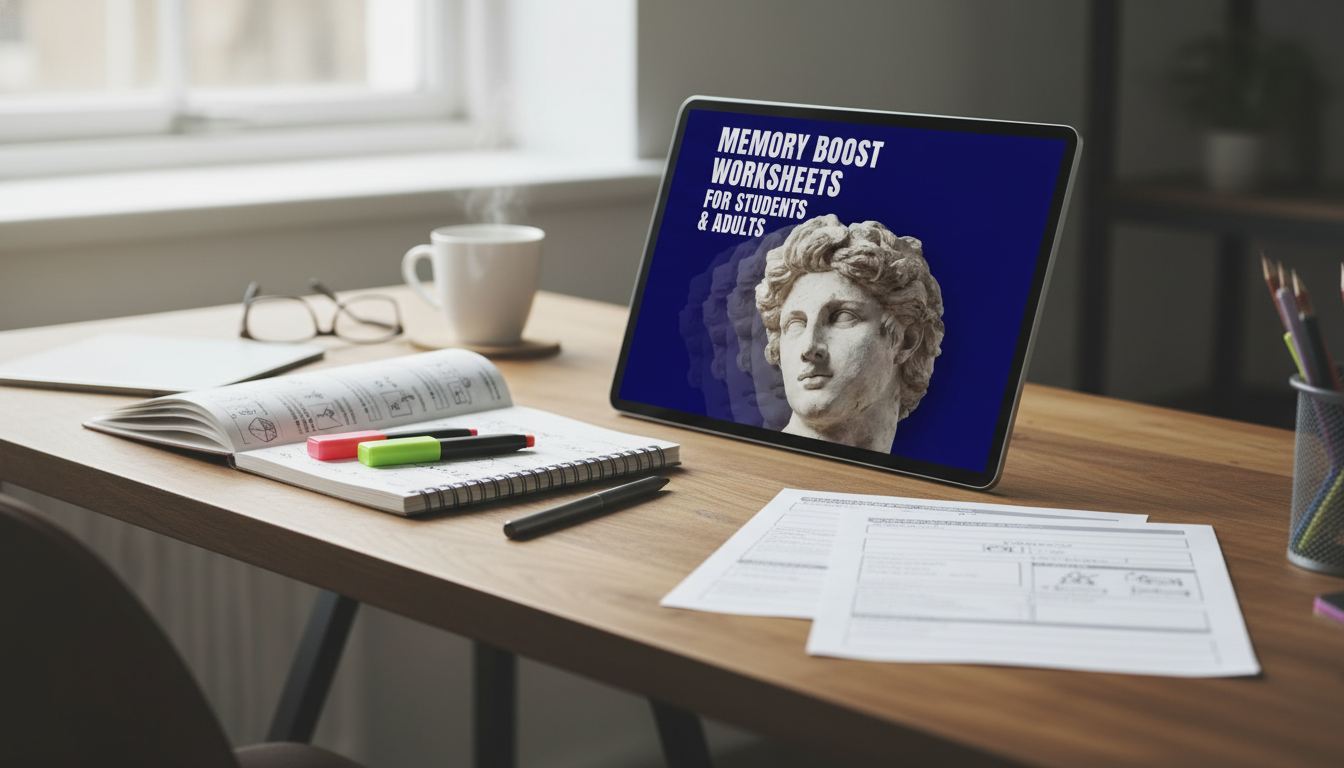
Memory Boost Worksheets for Students & Adults: Printable Exercises, Digital Practice, and Study Recall Tools
Better memory is less about “having a good brain” and more about using repeatable systems. A structured set of worksheets can turn scattered study time into targeted practice: encoding information clearly, retrieving it on purpose, and building habits that make recall faster under pressure. This guide explains what memory worksheets are, how to use printable and digital formats effectively, and how to build a simple weekly routine for students and adults.
What memory worksheets help train
Memory worksheets work because they guide the same skills strong learners use automatically—then make those skills repeatable, measurable, and easier to stick with.
- Encoding: turning new information into a format the brain can store (organization, meaning, mental images, associations).
- Retrieval practice: actively pulling information from memory rather than re-reading notes, which strengthens recall pathways.
- Working memory and attention: holding and manipulating information long enough to use it (steps, sequences, multi-part problems).
- Study stamina: reducing start-up friction by following a guided page instead of deciding “what to do” each session.
- Metacognition: noticing what is actually remembered vs. what only feels familiar.
Common worksheet activities and what they’re good for
| Worksheet activity | Best for | When to use it |
|---|---|---|
| Free recall prompts (write everything remembered) | Exam prep and presentations | After reading a chapter or finishing a lecture |
| Cued recall (question + blank answer space) | Facts, definitions, formulas | Daily short sessions; rotate topics |
| Chunking and outlining grids | Complex topics and long readings | Before memorization; to structure notes |
| Mnemonic builders (acronyms, peg words, loci routes) | Lists and sequences | When material must be recalled in order |
| Spaced review tracker | Long-term retention | Across a week/month to schedule re-checks |
Printable vs. digital download: choosing the right format for daily practice
The “best” format is the one you’ll use consistently—yet print and digital each solve different problems.
- Printable sheets are ideal for distraction-free sessions, quick annotation, and visible progress (a completed stack builds momentum).
- Digital pages work well for on-the-go practice, reusing templates, and storing completed work in a single folder.
- A hybrid approach often sticks best: print core exercises for deep work and use digital copies for quick refreshers.
- For students: keep a small set of printed pages in a binder; reserve digital practice for short review blocks between classes.
- For adults: use digital templates during commutes or breaks, then print weekly review sheets for a focused weekend session.
For science-backed context on everyday memory changes and improvement strategies, see the National Institute on Aging and Harvard Health Publishing.
What’s inside the Memory Boost Worksheets set
If you want a ready-to-use set of prompts that supports both academic study and real-world recall, Memory Boost Worksheets for Students & Adults (Printable Digital Download) is built for repeatable practice rather than one-off “tips.”
- Brain-training exercises designed for both students and adults, with guided prompts that encourage active recall.
- Memory techniques practice pages (e.g., association, visualization, chunking, and structured review).
- Study and recall tools that help turn notes into questions, strengthen retrieval, and track what needs revisiting.
- A practical format for self-study, tutoring support, or continuing education—use pages as stand-alone drills or alongside a course.
- Digital download access makes it easy to start immediately, then print the pages that work best for current goals.
A simple 20-minute routine (3–5 days per week)
Short sessions reduce resistance and make it easier to maintain spacing—one of the biggest drivers of long-term retention.
- Minutes 1–3: Set a target. Choose one topic and define what “remembered” means (definitions, steps, or a short explanation).
- Minutes 4–10: Active recall worksheet. Answer from memory first; only then check notes and correct with a different color.
- Minutes 11–16: Technique drill. Convert missed items into a mnemonic, chunked outline, or visual association.
- Minutes 17–20: Spaced-review scheduling. Mark what to revisit tomorrow, in 3 days, and in 7 days based on difficulty.
Consistency beats marathon studying for long-term retention—and it also helps you spot what’s improving (and what needs a new cue) week after week.
Memory techniques that pair well with worksheets
Worksheets are most effective when each page “forces” a proven strategy rather than leaving you to default to passive review.
Retrieval practice is widely recognized in psychology; a quick reference point is the American Psychological Association Dictionary.
Who benefits most (and how to adapt the pages)
Getting better results: common mistakes to avoid
Useful add-ons for focus and consistency
Two options that fit well alongside memory practice are Break the Tension: Stress Relief Techniques for fast calming tools and the Step-by-Step Career Development Guide for keeping learning goals and professional milestones organized.
FAQ
Are these worksheets better for students or adults?
They work for both. Students often use them to turn chapters and lectures into recall questions for exams, while adults use the same pages to retain terminology, processes, and presentation talking points; you can scale difficulty simply by choosing more complex material.
How long does it take to notice improvement in recall?
Many people notice smoother recall on the specific topics they practice within 1–2 weeks, especially with consistent retrieval and corrections. Stronger habits and more reliable long-term retention typically build over 4–6 weeks with spaced review.
Do I need to print the pages, or can everything be done digitally?
Either works. Print is often more distraction-free and easier for quick marking and visible progress, while digital templates are convenient for repeating exercises and keeping everything in one place; a hybrid approach tends to be the most sustainable.









Leave a comment